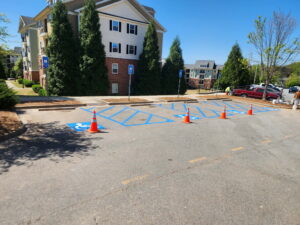
The familiar white wheelchair symbol painted on blue pavement, handicap parking stencil, has a relatively recent history, shaped by changing attitudes toward accessibility and disability rights.
Origins of Accessible Parking
Before the mid-20th century, there were no standardized parking accommodations for people with disabilities. As car ownership expanded after World War II, mobility became essential to daily life, but infrastructure didn’t keep up. Early efforts to reserve parking for disabled drivers began informally in the 1950s and 1960s, often using simple signs without consistent symbols.
The Birth of the Symbol
The turning point came in 1968, when the organization Rehabilitation International held a design competition to create a universal accessibility symbol. The winning design—created by Susanne Koefoed—featured a stylized white wheelchair on a blue background.
Shortly afterward, Selwyn Goldsmith modified the symbol to include a head, making it more clearly represent a person rather than just a chair. This updated version became known as the International Symbol of Access (ISA) and began appearing on signage worldwide.
Standardization in the United States
In the U.S., the symbol gained widespread use during the 1970s and 1980s as states began introducing disabled parking permit programs. However, it wasn’t until the passage of the Americans with Disabilities Act of 1990 that accessibility requirements—including parking—were standardized nationwide.
Under ADA guidelines:
-
Accessible parking spaces must be clearly marked
-
The ISA must be displayed on signage
-
Pavement markings (stencils) are commonly used to reinforce visibility
The Stencil Itself
The handicap parking stencil evolved as a practical tool for contractors and municipalities. Instead of hand-painting the symbol each time, reusable stencils ensured:
-
Consistency in size and proportions
-
Faster application across large parking lots
-
Compliance with federal and local regulations
Today, stencils are typically used with traffic-grade paint or thermoplastic markings, and they’re often paired with blue-painted backgrounds to maximize visibility.
Modern Updates and Debate
In recent years, some groups have advocated for updating the symbol to reflect a more active, independent image of people with disabilities. One example is the “Accessible Icon Project,” which redesigns the figure to appear in motion. While some cities and states have adopted variations, the original ISA remains the official standard under federal guidelines.
Lasting Impact
What began as a simple design has become one of the most recognizable symbols in the world. The handicap parking stencil is more than just a marking—it represents decades of progress toward accessibility, inclusion, and equal access to public spaces.
If you need help making sure your business’ parking spaces are up to code visit us at bcs-services.com or contact matt@bcs-services.com