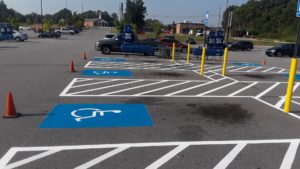
When you pull into a parking lot, you’ll often see symbols stenciled onto the pavement — arrows for direction, lines for spaces, and special markings like the wheelchair symbol for accessible parking. These stencils are more than paint; they’re part of a standardized system designed to keep traffic organized and ensure accessibility.
The Handicapped Parking Symbol
The most recognizable stencil is the International Symbol of Access (ISA) — a white wheelchair icon on a blue background. It was created in 1968 by Danish design student Susanne Koefoed, who submitted the design to a competition organized by the International Commission on Technology and Accessibility. The goal was to create a simple, universal icon that could be recognized across languages and cultures. The symbol quickly gained worldwide adoption and became the standard marking for accessible parking spaces, restrooms, and building entrances.
Standardization of Symbols
In the U.S., the Manual on Uniform Traffic Control Devices (MUTCD), maintained by the Federal Highway Administration, sets guidelines for road and parking lot markings. This ensures that symbols — whether they indicate accessible parking, fire lanes, loading zones, or directional arrows — look the same everywhere. Standardization helps drivers immediately understand the meaning, reducing confusion and improving safety.
Other Common Parking Lot Stencils
-
Arrows guide traffic flow and reduce accidents.
-
Crosswalks alert drivers to pedestrian pathways.
-
Reserved space labels (such as “VISITOR” or “STAFF”) organize parking.
-
Fire lane markings identify no-parking zones for emergency access.
Why They Matter
Parking lot stencils aren’t just about order — they play a critical role in safety, accessibility, and legal compliance. The wheelchair symbol, in particular, is backed by the Americans with Disabilities Act (ADA), which requires accessible spaces to be clearly marked.
In short: The stencil symbols we see in parking lots today originated from international design standards, safety regulations, and accessibility laws. They continue to serve as a universal language that makes public spaces safer and more inclusive for everyone.
If your business needs to get your parking lot up to code visit bcs-services.com or contact matt@bcs-services.com